

Claire Burt, founder of Burt’s Cheese, is one of a new band of UK cheesemakers investing her time, knowledge and resources into identifying exciting new commercial opportunities arising from the craft of affinage.
This Spring sees the launch of her brand-new cheese – one of the first commercially available cheeses to come out of Affineur of the Year.
Cheesemaking Hobby
Claire started making cheese as a hobby from her kitchen table in 2009. In 2013, she employed local chef Tom Partridge to assist in the dairy and he is now full-time cheesemaker (and affineur). Between the two of them they make and supply many local and national delis, farm shops and restaurants.

Since 2009 and up until last year, she had concentrated her efforts on just a few cheeses, which included her flagship cheeses: Burt’s Blue and Drunken Burt as well as a rotating range of limited edition cheeses, such as Divine, Little Burtle and Burt’s Blanc. She was happy with her range – comfortable in the familiar make processes and reliability of the recipes.
Survival Mode
When the pandemic hit, she went into “survival mode” – a response felt by many cheesemakers, when their regular source of income, that from restaurants, delis and exports dried up. Furthermore, Tom was furloughed, leaving Claire to manage the whole business alone. And then, as the restrictions lifted, Claire faced further interruptions with her regular milk supply, leading her into making the decision to relocate.

In 2023 she moved the dairy, literally uplifting her cheesemaking facility en-mass from Ash Farm in Knutsford to Bidlea Dairy in Holmes Chapel to allow her to be closer to a regular milk source, a business decision she has no regrets over. The dairy’s own herd of Holstein-Friesians provide a reliable and continuous supply of high-quality milk, just yards from their cheesemaking space.
Heavy Hitters of the UK Cheese Scene
And then in 2024, a conversation with Tracey Colley from the Academy of Cheese changed her outlook and pulled her out of this comfort zone. “Tracey persuaded me to compete in Affineur of the Year” (a competition that sees cheesemongers and cheesemakers from around the world showcasing the skill and artistry of affinage – the stage of cheesemaking that takes a young cheese and ages it to its full potential before sale. The competition has, over its short lifetime attracted heavy hitters of the UK cheese industry, all of whom have demonstrated enthusiasm for the pioneering spirit of the competition and pushed the boundaries of cheese innovation).


Claire felt privileged to be asked to enter and was in awe when she found herself in the same room, “standing shoulder to shoulder with the who’s who in the cheese world”. The cheeses sent out to competitors are made by UK cheese legends Jonny Crickmore from Fen Farm Dairy, Robin Skailes of Cropwell Bishop Creamery, Mary Quicke MBE of Quicke’s Cheese and Roger Longman of White Lake Cheese; whilst competitors included industry stalwarts from the likes of Paxton & Whitfield, Neal’s Yard Dairy, and Rennet & Rind: all associates she had looked up to over the course of her career.
What is Affineur of the Year?
The competition, launched in 2022 by the Academy of Cheese and Quicke’s, started with ten affineurs taking a young Quicke’s Clothbound Cheddar and maturing it over the course of 12 months. Now in its fourth year, the competition continues to expand and grow in popularity. With five categories now in play (this year competitors have the option to mature a young Gorwydd Caerphilly made by The Trethowan Brothers), there are already 12 affineurs signed up to compete.
Want to know more? Head to our competition page.
Claire and Tom went on to win the Blue Cheese Category of the competition for their Cropwell Bishop Blut Stilton, which they wrapped in vine leaves soaked in cider. Read a full report of the day here.

Cheshire Cheese Inspiration
The whole experience and air of innovation at the finals event last June led Claire to develop her new cheese. Wanting to pay homage to her Cheshire location, she decided to play around with a Cheshire cheese recipe. And whilst Bidlea Blue doesn’t technically follow a Cheshire recipe, it is more of a nod to a Cheshire style and much closer to a Cheshire than her signature “Burt’s Blue”, which is more akin to traditional blues.

And what of the affinage? Through her existing range of cheeses, Claire was already well accustomed to a diverse range of techniques: the wrapping of Divine, the piercing of Burt’s Blue and the washing of Drunken Burt. So why not tie them all together, she thought! And hence came Bidlea Blue – the fifth cheese in her repertoire.

How is the cheese made?
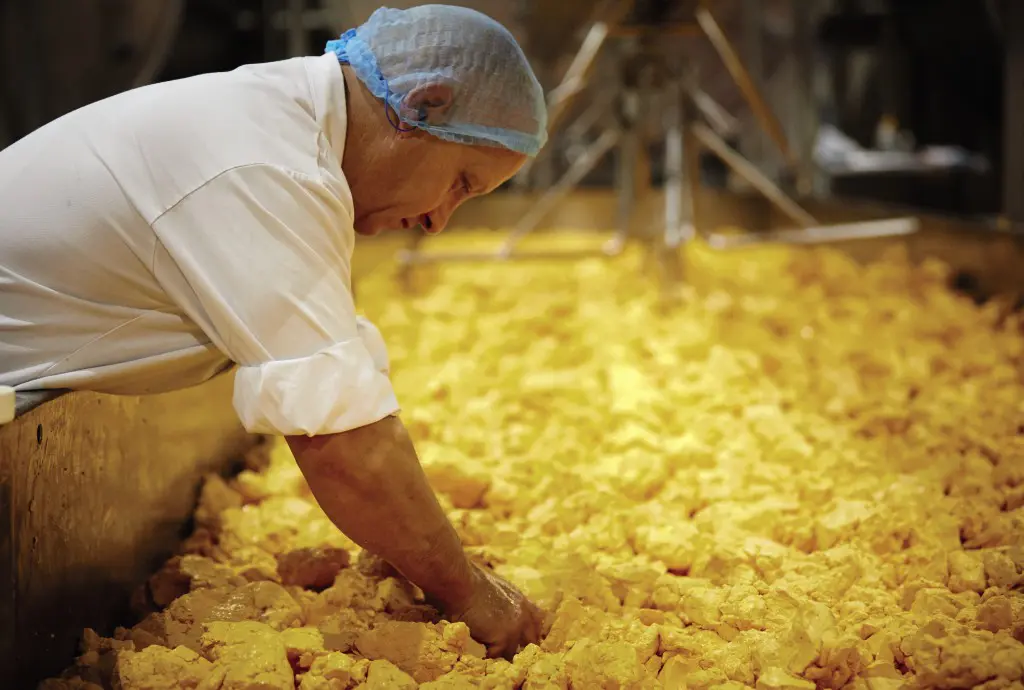
How does Bidlea Blue compare to Burt’s Blue? Claire uses the same pasteurised milk from Bidlea’s herd of Holstein-Friesians, along with Penicillium roquefortii and vegetarian rennet. However, that is where the similarities end. Bidlea Blue features a different starter culture, and the curds are stirred for longer, scalded in vat, before the whey is drained off and the curds moved to the draining table, before being milled and salted.
The curds are then scooped into moulds and stacked—rather than pressed, as with traditional Cheshire—to allow further drainage over the next 36 hours. After a week, the cheeses are pierced, and between Days 10 and 14, they’re wrapped in vine leaves soaked in Gwatkins Cider, a tribute to Tom’s Hereford roots. The cheeses are then matured in the maturing room for between 10 and 12 weeks, during which the first blueing appears, and the paste begins to break down under the rind.
The result is a larger format (2kg) cheese than her Burt’s Blue. It is a very distinctive, handsome-looking cheese, with a beautiful outer rind of hand-pasted, cider-washed vine leaves. Inside, the moist, yet crumbly paste imparts the yoghurty freshness of a traditional Cheshire combined with a boozy, fruitiness imparted from the cider-washed leaves, which gets spicier as it ages.

What advice would Claire give to cheesemakers thinking about venturing into creating a new cheese?
It’s a case of realising what you’re good at, combining that with what you know, whilst recognising the desire to try something different.
And what of the intricate wrapping? That, says Claire, is thanks to the unsolicited advice from Affineur judge and Lynher Dairies cheesemaker Catherine Mead and the ensuing discussion with her fellow judges, just prior to announcing Claire’s vine-wrapped Stilton as the winner of its category. Catherine divulged that they always wrapped their nettle-covered Cornish Yarg with the spines on the outside, whilst Claire had always wrapped their Divine with the spines facing inwards – for no reason other than she felt it was prettier.

Stepping Out of Her Comfort Zone
Claire is thrilled to have stepped outside her “day-to-day” routine. Not only has she learned countless new techniques, but she has also overcome mental challenges that once held her back. By breaking free from the familiar cycle of making the same four cheeses, she now feels more confident experimenting with new cheese styles.
This experience has shown Claire that there’s always something fresh to try. “If you’ve got a mould-ripened cheese, why not experiment with washing it? Or if you’ve got a washed rind cheese, how about trying to wrap it?” she says.
For those new to affinage, Claire advises taking things slow. “Focus on what you’re good at and what you know, but don’t push your resources too far.” She points out that new techniques often require new equipment and extra storage for maturation. The only new investment Claire made was in a mill, a tool that’s now a key part of her process.
If you’ve got a mould-ripened cheese, why not experiment with washing it? Or if you’ve got a washed rind cheese, how about trying to wrap it!
What’s Next?
Claire is thrilled with the results of her experimentation, revealing that Bidlea is “completely different from her existing range.” She’s excited about the prospect of connecting with a new customer base through a cheese with a distinct profile. Orders are already rolling in for her new creation, with interest from local restaurants, national cheesemongers and wholesalers, including The Fine Cheese Co., Cheese Shop Chester, Cheese Hamlet, The Crafty Cheeseman, Godfrey Williams and The Cheese Shop in Nantwich.










COMMENTS